Georgia Totto O'Keeffe (1887-1986)
Museum Collections Featuring Works by Georgia O'Keeffe
Highest Auction Prices for Georgia O'Keeffe
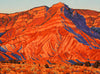
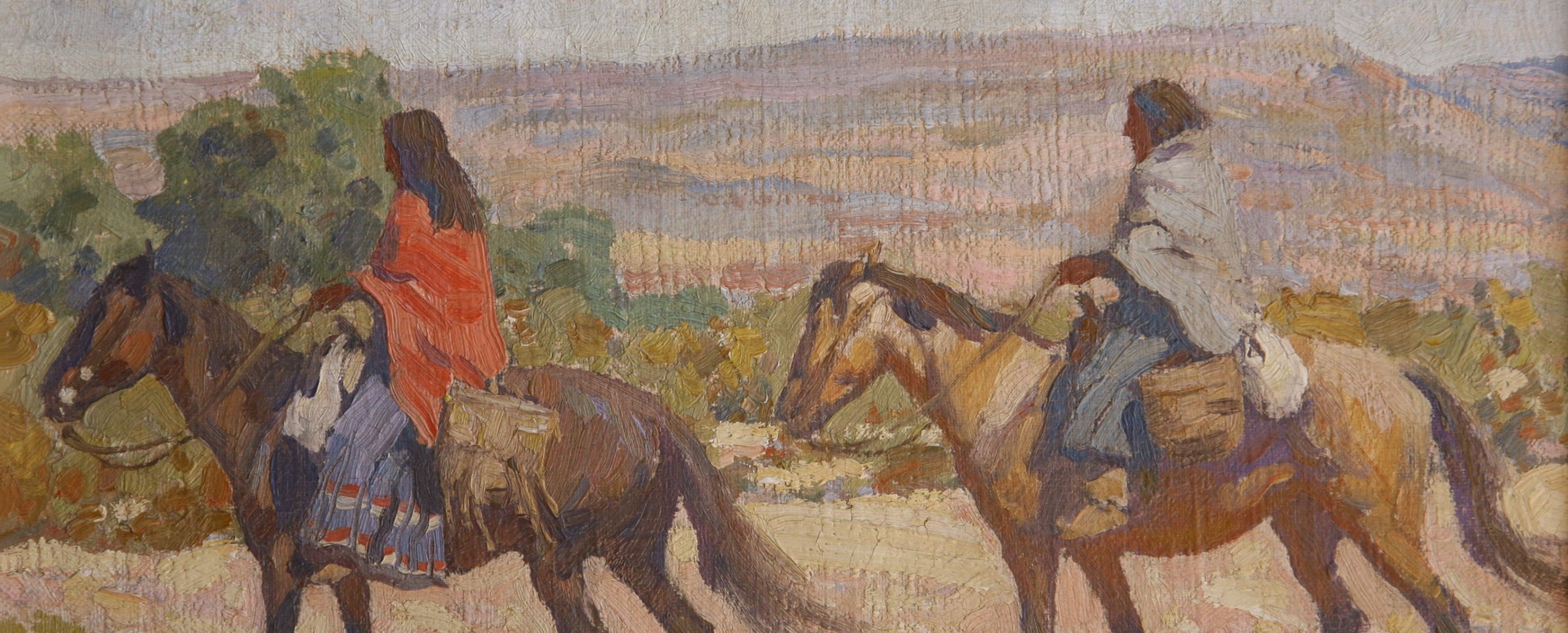
Georgia O'Keeffe, Road Past the View II,c. 1964, 18 x 30
"...I
often painted fragments of things because it seemed to make my statement as
well as or better than the whole could...I had to create an equivalent for what
I felt about what I was looking at...not copy it." Georgia O'Keeffe
When she received her high school diploma in 1905, Georgia moved to Chicago to attend the Art Institute of
Chicago. After a year she contacted
typhoid fever and later decided to head to the Art Students League in New York in 1907 rather than return to Chicago. At the League O'Keeffe won the William Merritt
Chase still-life prize, which was a scholarship to attend outdoor summer school
at Lake George, New York.
While she was there in 1908, she attended an exhibition at gallery 291, which
was owned by photographer Alfred Stieglitz who one day would become her
husband.
In her studies with William Merritt Chase and Frank Dumond
she found the strict adherence to realism stifling and so decided to quit
painting for a time. Four years later
O'Keeffe took a summer course for art teachers at the University
of Virginia, Charlottesville. Her instructor Alon Bement from Teachers
College, Columbia
University, introduced
O'Keefe to the new ideas of Arthur Wesley Dow.
Dow taught art as personal expression and a harmony of color, line and
value. She continued to work with these
ideas as she taught art in Texas public schools
or worked summers as Bement's assistant in Virginia.
While teaching at West Texas State Normal College
in 1916 she often took painting trips to the Palo Duro Canyon to enjoy the rich colors of the
sandstone formations.
Georgia's
friend Anita Pollitzer took some of her drawings to show Alfred Stieglitz, and
he remarked they were, "the purest, finest, sincerest things that had entered
291 in a long while." He showed them in
an exhibit without O'Keeffe's permission.
She confronted him, but eventually let the drawings hang. Her first solo show was at 291 in April 1917. Stieglitz offered to support Georgia to come for a year to paint in New York and she
accepted. It wasn't long before Alfred
had left his unhappy marriage and moved in with Georgia. He would take over 300 photographs of her
over the span of 1918 to 1937. He
continued to manage the sales and promotion of her art even after he closed
291. His wife filed for divorce in 1924
and he married Georgia
by the end of that year. For the next
several years the couple would spend winter and spring in Manhattan
and summer and fall in Lake George at the
Stieglitz family home.
The 1920s were a time of prolific work for Georgia. Many of her highly sought-after floral
paintings were created then. She also
completed a large body of New York
buildings and other architectural forms.
The first of the giant flower paintings called Petunia #2 was done in 1924 and the first exhibition of them in
1925. She received $25,000 in 1928 for a
series of six of her calla lily paintings, which was the largest sum ever paid
for a group of paintings by a living American artist. She
rarely signed a painting, but sometimes printed "OK" on the back of the canvas.
In 1929 she took a trip to New Mexico with a friend and fell in love
with the landscape and color of the desert.
She often called it "the faraway".
This was the beginning of many summer trips to Santa
Fe and Taos
between 1929 and 1949, where she often spent time at the homes of Mabel Dodge
Luhan and D.H. Lawrence. Being very much
a loner, she bought a Model A Ford and had someone teach her how to drive so
she could drive to a favorite site, sit in the back seat (turned around) and
paint with her canvas propped against the back wall of the car.
Georgia
suffered a nervous breakdown in 1932 following an uncompleted mural project for
the Radio City Music Hall. She was hospitalized in early 1933 and did
not paint again for nearly a year. After
her recovery in Bermuda, O'Keeffe discovered
the multi-colored cliffs of Ghost Ranch in the summer of 1934 and eventually bought
a house there in 1940. Also in the
1940s, she had two one-person museum retrospectives. One was at the Art Institute of Chicago in
1943 and the other at the Museum of Modern Art in New
York in 1946.
It was the first time a woman artist had been given a retrospective show
at MOMA. The Whitney Museum of American
Art sponsored a project to establish the first catalogue of her work in the
mid-1940s.
In 1945, Georgia
bought and abandoned hacienda in Abiquiu and renovated it for the next three
years. In the summer of 1946 she was
called home to New York
when Stieglitz suffered a cerebral thrombosis.
When he died in July of that year, she moved to New Mexico permanently. Throughout the 50s she used the architecture
and scenery around Abiquiu to inspire an extensive series of paintings. She also began traveling internationally and
painted a series of clouds inspired by the view from an airplane window.
O'Keeffe was elected to the fifty-member American Academy
of Arts and Letters in 1962 and given a retrospective in 1970 at the Whitney
Museum of American Art. This was the
first major exhibit she had done since Stieglitz died in 1946. In 1971 she became aware that her eyesight
was failing. In 1972 she stopped
painting, but began doing some pottery.
A young potter named Juan Hamilton had come to her house looking for work
and she had employed him for various odd jobs. He became a close friend and constant
companion. Now 84, she was suffering
from an eye disease that caused her to lose her central vision leaving her with
only peripheral vision. With Hamilton's help she wrote
a book about her art and allowed a documentary to be filmed about her life at
Ghost Ranch. In her late 90's she moved
to Hamiton's house in Santa Fe where he could take care of her, and she died at
age 98 on March 6, 1986. Juan scattered
her ashes from the top of the Pedernal
Mountain that she painted
so many times. She always said, "It's my
private mountain. It belongs to me. God told me if I painted it enough, I could
have it."
Selected Collections:
Art Institute of Chicago Collection
Georgia Totto O'Keeffe was born November 15, 1887 on a large
dairy farm in Sun Prairie, Wisconsin. Her father was a Hungarian immigrant and her
mother a descendent from Edward Fuller, a passenger on the Mayflower and a
signer of the Mayflower Compact. Georgia was one
of seven children and showed remarkable artistic talent at a very young
age. Her parents encouraged her by
providing five years of art instruction by the time she was sixteen.
Butler
Institute of American Art, Ohio
Dallas Museum
of Art, Texas
Fine Arts
Museum of San Francisco
Georgia
O'Keeffe Museum, New Mexico
Georgia
O'Keeffe at the Metropolitan Museum of Art, New York City
Museum of
Fine Arts, Houston, Texas
Museum of
Fine Arts, Boston
Museum of
Modern Art, New York City
Georgia
O'Keeffe at the National Gallery of Art, Washington D.C.
North
Carolina Museum of Art, Raleigh
San Francisco
Museum of Modern Art
The Phillips
Collection, Washington
D.C.
Yale
University Art Gallery, New
Haven, Connecticut
Bibliography:
1. Georgia O'Keeffe Museum
2. Metropolitan
Museum of Art, New York City
3. Museum of Modern Art in New
York
4. Public Broadcasting Service, Perry Miller Adato, WNET
Top